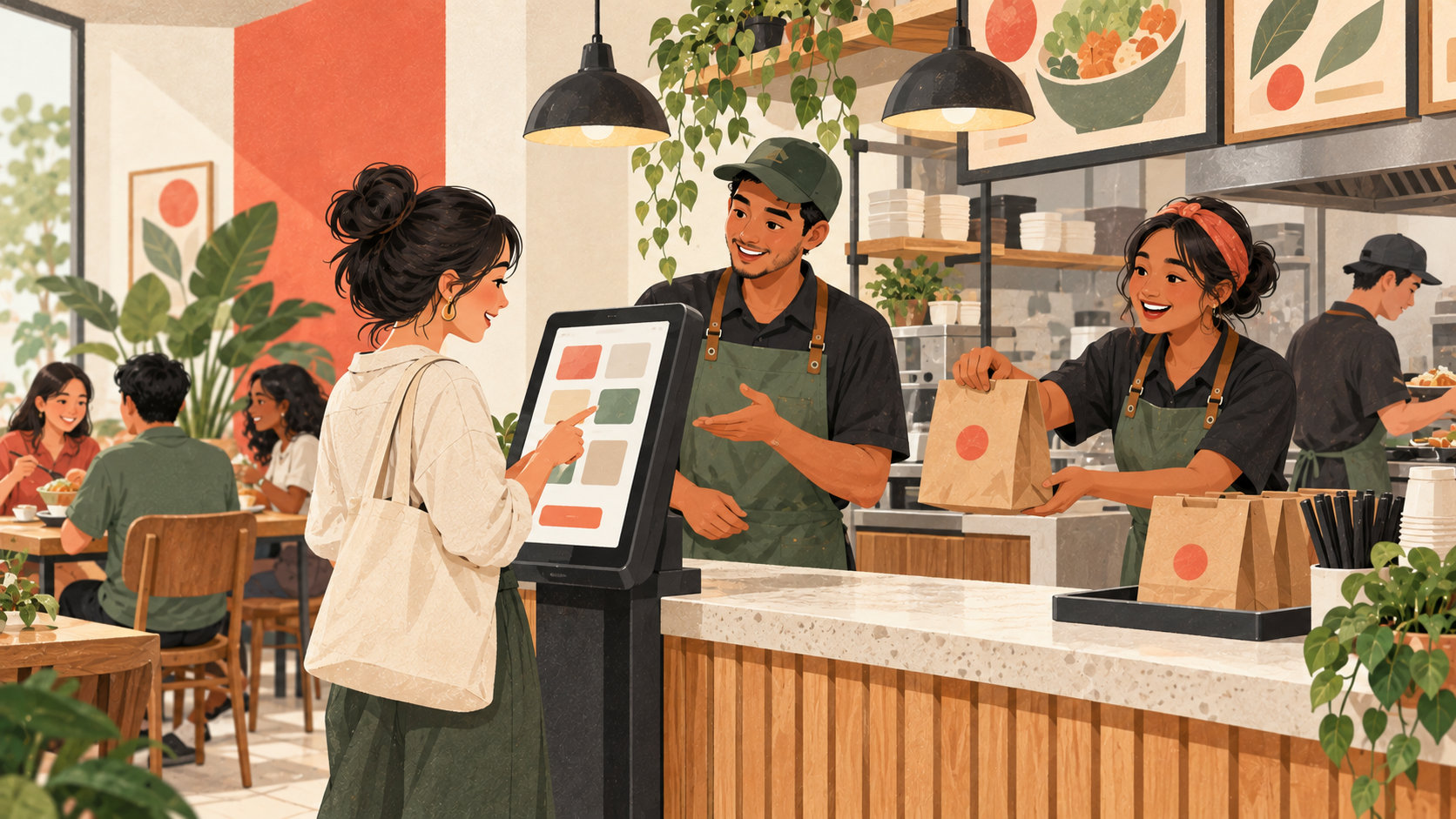

A multi-outlet POS connects locations. An omnichannel POS connects the ways guests discover, order, pay and return. An F&B group needs both: shared visibility across the business, with enough flexibility for each restaurant to trade differently.
Imagine one fictional Singapore group with a neighbourhood café, a city lunch counter and an evening restaurant. They share purchasing and membership, but have different menus, opening hours, service styles and prices. Opening another outlet is not simply copying the first till. The operating model has to travel with it.
Five pain points that deserve a place in your buying checklist
These five risks form a practical buying checklist drawn from the workflows below. IMDA’s Connected Business Suite guidance brings POS, kitchen, inventory and supplier management together. Assess the handovers as well as the checkout screen.
Local offers drift from group intent
A city outlet may need a different price and lunch assortment from a neighbourhood café. Uncontrolled copying can put the wrong offer on sale, while rigid uniformity ignores the location’s economics.
Ingredient costs disappear between kitchen and outlet
A shelf count misses supplier price changes, preparation yield, packaging, wastage and transfers. The central kitchen and centralised purchasing often determine the economics before an outlet serves its first guest.
Online promises outrun fulfilment
A guest orders an unavailable item or chooses a collection point that cannot prepare it. Separate channel records leave staff correcting the promise during service, when the guest expects a smooth handover.
Loyalty becomes inconsistent or too expensive
A regular should have more choices within the group, yet a reward suitable for a quick lunch may not suit a full-service concept. Disconnected member records and poorly scoped offers frustrate guests and obscure reward costs.
Managers see the problem after guests do
Unmatched payments, unclear outlet comparisons and slow follow-up delay action. A system that cannot handle these handovers can cause lost sales immediately, service recovery work and bad experiences that may become negative reviews.
CommerceOS: one platform, deliberate outlet differences
Rewardly CommerceOS is a strong foundation for this model. Its menus can assign different assortments to different outlets; product visibility controls the selling channels. Online order hours, blackout dates and preparation padding help each location make promises its team can fulfil.
Plan location pricing deliberately. For example, the fictional city restaurant might keep the standard price while the neighbourhood outlet runs a lower weekday offer. Pricing Rules and Tiers can target outlet, time, channel, quantity or membership. A matching tier only reduces the applicable price; it does not add a surcharge. Test the intended base prices and promotions rather than assume every pricing rule can raise a bill.
Your shopfront, connected to the outlets that fulfil it
Rewardly’s branded eCommerce offering lets a group plan its own domain, identity and shopping journey around CommerceOS. Connect outlet selection, availability, pre-order lead times and collection or delivery to the actual fulfilment team. The proposal defines which outlets, modules and data flows are connected. A branded storefront should extend the operation, not create another inbox to reconcile.
Cost the supply journey, not just the stock on the shelf
StockOS supports ingredient recipes and per-outlet ingredient balances. With tracking enabled, a product made at the selling outlet consumes its configured recipe when sold. Receiving supplier orders updates ingredient stock and purchase prices; the selected average or latest purchase-price method feeds recorded sale costs. Accurate records still depend on correct recipes, units, receipts and recorded waste.
A central kitchen follows a different path: make a batch, deduct its ingredients at the kitchen, send the finished stock, then receive the actual quantity at the outlet. The outlet sells that stock without deducting the same ingredients again. Record preparation losses, short deliveries and transfers. Labour, rent and distribution also matter to management costing; inventory records alone are not a complete profitability calculation.

LoyaltyOS: a group relationship with a considered reward economy
Build a shared member relationship across the group’s eligible outlets. LoyaltyOS programmes can scope earning to selected outlets, with membership-linked rates and product-level earning overrides. Voucher eligibility can shape where a benefit is used. This gives different concepts room to match rewards to their revenue model while guests explore more of the same group.
Keep the promise understandable: the documented points cash value is set at merchant level, so do not assume each outlet has an independent point currency. Redemption conditions also differ by channel: online, QR and kiosk caps do not apply identically at the POS. Rehearse cross-outlet earning and redemption before launch. A wider choice of places and occasions can strengthen reasons to return; retention is an objective to measure, not a guaranteed result.
See the question behind the totals
Ask a practical question such as “Compare sales by outlet for this period” in the Smart Report Builder. Its current sales reports combine selected dates, outlets and sources with charts, underlying rows and AI-written interpretation. AInstein guidance helps colleagues understand the workflow; the separate reporting tool analyses supported sales data. Review the evidence before changing an offer or investigating a branch.
Today, central-admin campaigns and Campaign Bots support configured audiences, messages and recurring conditions for enrolled members. Check the segment, consent, offer and messaging credits. Predictive high-risk customer detection with automatic recovery is a planned capability, described separately below. A sales comparison is not a churn prediction or proof of what caused a change. A Singapore Business Review report of 23 October 2026, covering Retail Asia Summit discussion, also emphasises specific business needs and clear AI rules.
PaymentOS: bring outlet payment records into the review
PaymentOS reports group payments by tender, with outlet, register and source filters, plus PayNow payout and discount views. This gives finance a consistent place to review collections across the chosen scope. Connected payment setup can reduce repeated configuration work when opening outlets; provider approval, training and rollout timing still need agreement. Assess the full payment proposal, including fees, rather than assume integrated records mean every settlement has already been reconciled.
Follow the operating loop
Illustrative workflow, not an actual product screen. Select a step or play the sequence. Every step remains readable without animation.
HQ agrees shared standards; each outlet has its intended menu, hours and prices.
The kitchen records production and transfers; the outlet confirms what arrived.
A guest books or orders through the appropriate entry point and eligible outlet.
The team serves the order and retains the relevant stock and payment records.
Members earn and redeem under the group’s configured outlet and channel rules.
Managers compare supported reports, investigate exceptions and agree the next action.
Test the depth of the operating model
Rewardly’s value is the connection between configurable commerce, recipe and central-kitchen stock, member programmes and payment review. That is a stronger operating fit than a system limited to identical outlet catalogues and isolated transaction records. It is not a claim that every competing platform lacks these features. Ask any provider to demonstrate one complete journey, including an outlet exception, a short stock receipt, a reward restriction and the finance review.
Enterprise by design, from the first booking to the next visit
Rewardly’s product design is enterprise-oriented by nature: shared operations with room for different concepts and scoped integrations. RewardlyPRO provides a practical route to high-complexity deployments, validated through discovery, a pilot and an agreed rollout. Add TableReady to engage guests at the beginning of the lifecycle through bookings, outlet-specific availability and the arrival-to-seating handover. Bring your most difficult real scenario to a Rewardly demonstration and test the whole journey—not just a duplicate of outlet one.