
Why We Built Loyalty Program for POS System with Native Integration
- Kelvin Low

- Feb 3
- 4 min read
TABLE CONTENT
Two Common Approaches to Loyalty in POS Systems
	Rewardly LoyaltyOS
	3rd-Party Integrated Loyalty Program
Why We Treat Loyalty as a Foundation Layer
Native Module vs Integration
Interactivity
Omnichannel Loyalty Without Fragmentation
Time, Opportunity, and Speed to Market
How We See the Choice
As someone working closely with merchants across restaurants, retail stores, and beauty salons, I often get asked the same question:
“What’s the real difference between a POS with built-in loyalty and one that integrates with a 3rd-party loyalty program?”
At Rewardly, this question shaped how we designed Rewardly LoyaltyOS from the ground up. Rather than treating loyalty as an add-on, we built it as a core capability within the POS workflow itself.
This article shares why we took that approach, what it enables for merchants, and how it compares structurally (not competitively) with POS systems that rely on a 3rd-party integrated loyalty program.
Two Common Approaches to Loyalty Program for POS Systems
Before going deeper, it’s important to clarify the two models most merchants encounter today.
Rewardly LoyaltyOS
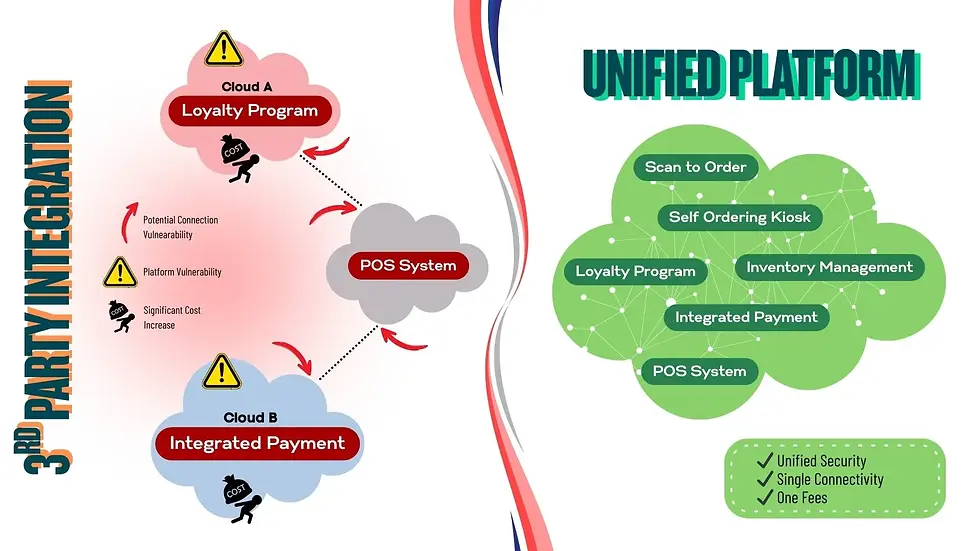
Rewardly LoyaltyOS is our loyalty system designed as a native module within the Rewardly platform. Loyalty logic—membership recognition, earning, redemption, vouchers, and cashback—is embedded directly into the POS transaction flow.
For merchants, this means loyalty behaves like a natural extension of the POS, not a separate system that needs to be synced.

3rd-Party Integrated Loyalty Program
A 3rd-party integrated loyalty program connects an external loyalty provider to a POS system through APIs. Customer data and rewards are exchanged between two independent systems.
This approach is widely used and can be effective, especially for merchants who already have an established loyalty provider or require very specific customisation.

Why We Treat Loyalty as a Foundation Layer
One of the first design decisions we made was to treat loyalty as a foundation layer, not a surface feature.
In daily operations, merchants value simplicity and reliability. When loyalty is native to the POS:
There are fewer repeated steps during checkout
Staff training becomes easier
The risk of workflow interruptions is reduced
By contrast, API-based integrations naturally involve handoffs between systems. Each handoff is manageable—but it also introduces more moving parts that merchants need to account for operationally.
Our goal with Rewardly LoyaltyOS was to keep the workflow agile, lightweight, and predictable, especially during peak hours.
Native Module vs Integration: Stability and Practical Cost Considerations
Because Rewardly LoyaltyOS is a module within the same platform, it does not depend on external APIs to process transactions. This reduces dependency on version changes, rate limits, or cross-vendor troubleshooting.
From a cost perspective, many merchants tell us they appreciate the simplicity of:
One subscription model
One support channel
One system to maintain
That said, a 3rd-party integrated loyalty program can still be a valid option—particularly for businesses that prioritise vendor flexibility or already operate multiple systems.
Our focus is not to replace every integration scenario, but to offer an alternative that reduces technical and operational overhead where possible.

Interactivity: The Moment During the Transaction
In most POS workflows, we talk about what happens before and after a transaction. But from our experience, the most valuable engagement moment happens in between—when payment is about to be completed.
With many 3rd-party integrated loyalty programs, membership signup typically occurs before checkout. If the customer decides to join at the counter, staff may need to pause or redirect them to another step.
Rewardly LoyaltyOS was designed to treat this differently. Because loyalty is native, membership signup, reward earning, and redemption can happen seamlessly within the transaction itself.
For merchants, this often results in:
Higher signup rates
Shorter queues
A smoother, more modern brand experience

Omnichannel Loyalty Without Fragmentation
Today’s customers don’t interact with a business through just one channel. They may order in person today, use Scan-to-Order tomorrow, and use a kiosk next week.
Rewardly LoyaltyOS is omnichannel-ready by design, offering a consistent loyalty experience across:
In-person POS
Scan-to-Order
Self-ordering kiosks
Rewards earned in one channel are reflected in real time across others.
With API-integrated loyalty setups, adding channels often means adding more touchpoints and more coordination. This doesn’t mean it can’t work—but it does increase system complexity and operational considerations.
Our approach aims to keep that complexity invisible to both staff and customers.

Time, Opportunity, and Speed to Market
One area merchants don’t always factor in is opportunity cost.
Launching a loyalty program isn’t just about software—it’s about timing. Seasonal promotions, new outlet openings, or competitive moments don’t wait.
From our observations, 3rd-party integrated loyalty programs often require:
Longer conceptualisation phases
Cross-vendor alignment
Extended testing cycles
With Loyalty Program for POS system such as Rewardly LoyaltyOS, merchants can configure and launch campaigns within the same system they already operate, reducing time from idea to execution.
How We See the Choice
We don’t believe there is a single “right” loyalty model for every business.
A 3rd-party integrated loyalty program can be suitable for merchants with specific needs, existing vendor relationships, or complex ecosystems.
Rewardly LoyaltyOS is designed for merchants who value:
Operational simplicity
Native omnichannel experiences
Lower system dependency
Faster adaptability
Our role is to provide a platform that supports modern customer engagement while fitting naturally into daily operations.
Closing Thought
At Rewardly, we didn’t build LoyaltyOS to replace integrations—we built it to remove friction where friction doesn’t need to exist.
For merchants evaluating loyalty strategies today, understanding how loyalty is architected is just as important as the features listed in a brochure. When loyalty works quietly in the background, businesses can focus on what matters most: serving customers better.


Comments