
The Hidden Tax of 3rd Party Integrated Loyalty Programs Nobody Talks About
- Kelvin Low

- Dec 9, 2025
- 5 min read
Updated: Dec 12, 2025
Loyalty programs have become a vital strategy for businesses to retain customers and drive repeat sales. However, the way these programs are implemented can differ significantly. Two common approaches are:
3rd Party Integrated Loyalty Programs, where the loyalty component is linked to an existing POS or sales system through APIs.
Unified selling platforms, where loyalty features are natively built into the same system that manages sales, customers, payments, and inventory.
While both approaches may appear similar on the surface, they behave very differently behind the scenes. Understanding their implications on stability, cost, usability, data quality, and customer engagement can help business owners make wiser long-term decisions.
Understanding 3rd Party Integrated Loyalty Programs
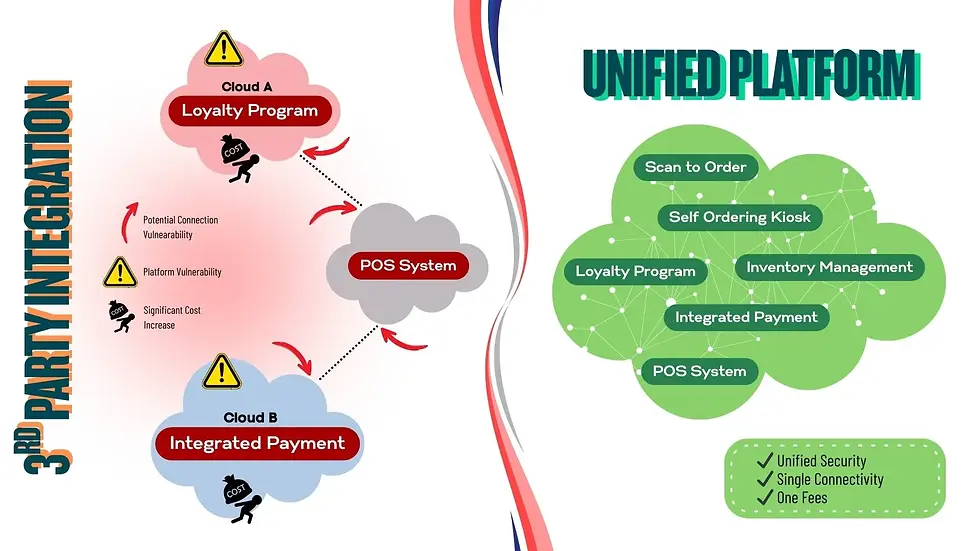
A 3rd-party integrated loyalty program connects a standalone loyalty system to an existing POS or sales platform via application programming interfaces (APIs). This allows businesses to add loyalty features without replacing their current sales infrastructure.
Advantages of 3rd Party Integration
Flexibility: Businesses can select specialized loyalty providers that offer advanced features.
Customization: APIs allow unique program structures tailored to different industries or business models.
Incremental adoption: Loyalty programs can be added without replatforming or changing existing workflows.
These advantages are especially appealing for companies that wish to preserve their current system environment.
😱 Challenges and Costs of 3rd Party Integrated Loyalty Systems
Despite their benefits, 3rd-party integrations introduce operational fragility and ongoing technical debt that often become more visible over time.
1. System Upgrades Create Disruption
When the host POS or sales system undergoes version changes, UI updates, or data structure adjustments, the API connections can break or behave inconsistently. This may lead to:
Incorrect point calculation
Failed voucher redemptions
Transaction delays during checkout
Customer service complaints and escalations
Businesses may continue to sell without loyalty, but customer experience immediately deteriorates, and manual adjustments consume time and labor.
2. Continuous Maintenance and Monitoring
The loyalty provider must consistently update and test their integration to ensure compatibility. This requires:
Ongoing engineering hours
Regression testing
Emergency patch cycles when disruptions occur
Manual reconciliation for mismatched loyalty data
This introduces hidden operational overhead that is rarely reflected in initial project estimates.
3. Higher Total Cost of Ownership
Even when everything functions properly, multiple components make the solution expensive to maintain:
Two separate system licenses
Two support teams coordinating for issue resolution
Parallel monitoring and QA
Higher risk of unexpected outages during POS upgrades

4. Loss of Opportunity Cost from Platform Misalignment
As the host POS or sales system evolves, it frequently introduces new promotional logic, product structures, pricing rules, customer grouping, or real-time automation features. However, the host software always advances faster than its API layer, which must remain backward-compatible and stable across multiple versions and integrated vendors. This creates a functional misalignment, preventing loyalty execution from leveraging new capabilities until the API is enhanced and revalidated.
This often results in:
Delayed support for new product variants or selling models
Inability to adopt advanced promotional structures or bundled rewards
Slower rollout of cross-outlet or tier-based engagement strategies
Missed real-time triggers or in-cart loyalty interaction
Higher reliance on manual intervention to make promotions work
Even if the POS platform is technically capable, the loyalty system becomes constrained by API limitations, slowing innovation, campaign deployment, and customer engagement initiatives. Over time, this misalignment incurs significant opportunity costs, preventing retailers from fully leveraging the strengths of their selling platform and resulting in lost competitive advantage and slower loyalty adoption.
In short, 3rd Party integrations require constant attention to remain compatible, and this burden increases as transaction volume or store count grows.
A 2023 industry survey found that 65% of businesses using 3rd-party integrated loyalty programs experienced at least one significant disruption annually due to host system changes, which affected customer satisfaction and operational reliability.
🏆 Unified Selling Platforms — A Better Path Forward
Unified selling platforms embed loyalty programs directly into the same system that powers product catalogs, pricing, promotions, order processing, customer profiles, payments, and inventory. This means loyalty execution is part of the core sales logic, not a bolt-on component.

1. Stability and Predictability
System updates are handled internally with full awareness of how each module affects the others:
No API compatibility risk
Lower QA effort
Predictable behavior across upgrades
Faster release cycles with minimal disruption
For multi-outlet operations and high-transaction-volume businesses, this translates into dramatically higher operational uptime.
2. Consistent User Experience
Front-line operators interact with one platform:
One UI
One login
One workflow
One training process
This simplifies onboarding, reduces cashier errors, and improves adoption. Businesses avoid the confusion and inefficiencies of managing disconnected systems.
3. Faster Innovation
Because loyalty logic is part of the same platform:
New campaign rules go live instantly
Cross-outlet promotions can be deployed without coding
Test-and-learn cycles are faster
No dependency on external coordination
Unified architectures make loyalty more agile, more responsive, and more powerful.
💫 Interactivity: The Unified Platform Advantage
A significant limitation of 3rd-party Integrated Loyalty Programs is the lack of real-time interaction during checkout. Loyalty logic is typically applied after order submission, not during item entry.
Unified platforms offer something 3rd-party integrations struggle to deliver:
Real-Time Loyalty Execution
As items are added to a cart:
Points, vouchers, discounts, and tiers are calculated instantly
Eligibility logic is applied automatically
Customers see benefits before final payment
Staff no longer need manual overrides
Why Real-Time Matters
Shorter checkout times
Higher campaign adoption
Accurate reward issuance
Better customer trust and satisfaction
A multi-store retailer that upgraded from a 3rd-party Integrated Loyalty solution to a unified commerce platform reported:
30% reduction in checkout time and20% increase in loyalty participation within six months
Real-time interactivity is extremely difficult to guarantee reliably when loyalty logic is dependent on asynchronous API responses.
⚠️ Cost, Maintenance, and Operational Risk
3rd Party Integrated Loyalty Programs
Multiple vendors increase complexity
Higher QA cycles and regression testing
Higher likelihood of downtime during major POS updates
More reconciliation effort when data mismatches occur
Higher operational cost at scale
Unified Platforms
One vendor, one support channel
Internal updates remain fully compatible
Lower regression risk
Reduced long-term maintenance
Lower total cost of ownership for multi-outlet operations
A mid-sized retail group documented 40% lower loyalty system maintenance costs after switching to a unified platform with native loyalty execution.
🎯 Unified Data = Better Decisions
When all operational data — sales, loyalty, customer behavior, stock movement, and payment — exists inside one ecosystem:
Analytics become more accurate
Customer segmentation becomes easier
Predictive modeling (like churn or frequency) becomes more actionable
Cross-outlet patterns are easier to identify
Fraud risk is easier to monitor and investigate
3rd Party integrations create fragmented datasets, requiring:
Manual cleaning
External BI tools
More operational overhead before insights become usable
Unified platforms deliver clean, authoritative data with higher integrity and less manual dependency.
⚖️ Vendor Lock-in vs Operational Freedom
3rd-Party Integrated Loyalty Programs offer greater flexibility if the business frequently wants to replace loyalty vendors. However, that flexibility comes with:
Higher cost
Higher disruption risk
Lower interactivity
Slower rollout cycles
Unified platforms offer:
Greater operational consistency
Higher customer adoption
More real-time engagement
Lower long-term maintenance
For most SMEs, especially those with limited manpower, unified platforms deliver meaningfully higher operational leverage.
Final Takeaway
Modern loyalty is no longer just about issuing rewards — it must be embedded, real-time, interactive, and reliable, especially for SMEs operating in a hybrid retail and F&B environment.
Businesses that prioritize:
Unified experience
Operational stability
Fast rollout cycles
Lower support burden
Accurate analytics
Real-time customer engagement
Lower total cost of ownership
…will benefit most from a unified commerce platform with built-in loyalty, rather than depending on a 3rd-party Integrated Loyalty Program.
For SMEs, where time, manpower, and operational consistency are critical, unified platforms provide measurable advantages that standalone loyalty systems cannot match.


Comments