
The Modern Café Playbook: How Smart Technology (Cafe POS) Transforms Daily Operations
- EPOS Expert

- Dec 12, 2025
- 4 min read
TABLE CONTENT
Young professionals & students
Office crowd
Families & casual diners
Tourists & visitors
Loyal regulars
Walk-in ordering
Manual order-taking and coordination
Kitchen fulfilment challenges
Customer waiting experience
End-of-day manual reconciliation
Limitations of manpower-heavy operations
4.1 Expanding Order Channels
Scan-to-order (QR ordering)
Self-ordering kiosk
4.2 Streamlining Order-to-Fulfilment
Kitchen Display System (KDS)
Expedite display for customer visibility
4.3 Ingredient-Level Stock Management
Automated menu availability
Real-time inventory tracking
4.4 Unified Delivery Platform Orders
GrabFood integration
FoodPanda integration
4.5 Enhancing Customer Experience with Loyalty Program
First-time customer conversion
Repeat customer retention
Personalised promotions
4.6 Reliable Payment Processing
Higher approval rates
Minimising payment failures
Sales data sync
GST & reconciliation automation
Faster closing cycles
Seamless monthly GTO submission
Improved accuracy & compliance
The café of the future
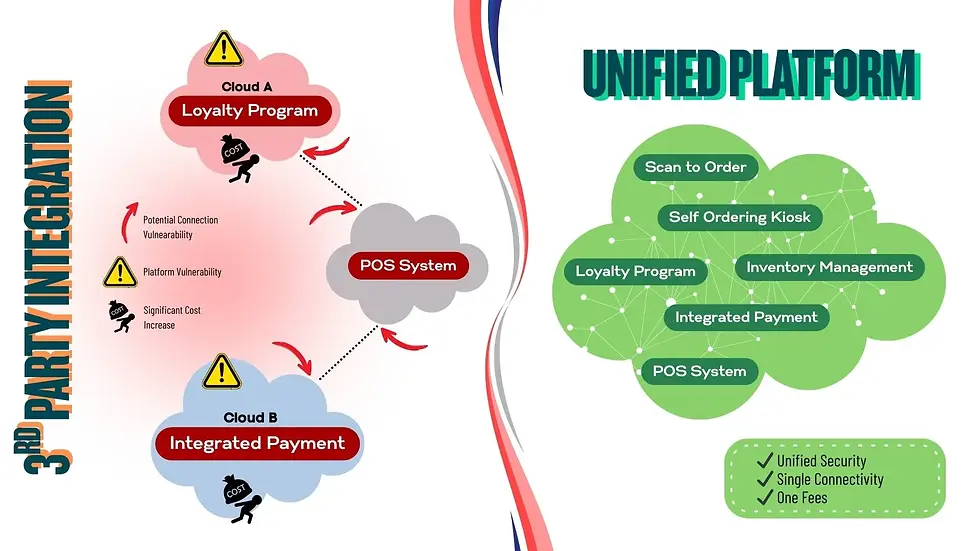
How connected systems form the new competitive edge
Running a café today is no longer just about brewing great coffee. The modern café operates in an environment shaped by fast-changing customer expectations, rising costs, manpower challenges, and intense competition. To stay ahead, cafés must pair operational excellence with the right technology to create a seamless experience from ordering to fulfilment, payments, loyalty, and back-end processes.
We explores the end-to-end modern café operations workflow, the challenges traditional setups face, and how technology dramatically enhances efficiency and profitability.
1. Understanding Café Target Customers
Every café attracts a unique blend of customers, but most modern cafés serve a combination of:
Young professionals & students
People who want fast service, a place to work or study, and digital-first convenience.
Office crowd
Looking for quick lunch options, efficient service, and cashless payments.
Families & casual diners
Prefer clear menus, flexible ordering options, and predictable wait times.
Tourists & visitors
Rely on QR ordering, card payments, and English-friendly workflows.
Loyal regulars
Come back for service consistency, personalised offers, and member rewards.
Understanding these segments allows cafés to design workflows that reduce friction and meet expectations for speed, convenience, and personalisation.
2. Traditional Café Operation Workflow: Where the Bottlenecks Begin
Many cafés still follow a traditional process:
Customer walks in
Front-counter ordering at the with a cashier
Order handwritten or keyed manually into the cafe POS
Kitchen staff verbally informed or given printed dockets
Food & drinks prepared
Staff calls out the order number manually
Customer waits, watches, or listens for their order
Reconciliation and reporting are done manually at the end of the day.
While this setup works, it has several challenges:
Long queues during peak hours
Human errors in order taking
Difficulty managing menu availability
Slow fulfilment due to miscommunication
Lack of visibility for customers waiting
Duplicate effort due to manual accounting
No structured way to understand or engage customers
No integration with GrabFood / FoodPanda, causing inconsistencies
This workflow is labour-dependent, error-prone, and unable to scale efficiently.
3. How Cafe POS Enhances the Café Workflow
Modern café technology changes the entire customer journey—making operations smoother, faster, and more profitable.
A. Extend Order Channels Beyond In-Person Ordering
Customers today expect flexible ways to order:
Scan-to-Order (QR Ordering) - Customers scan a QR code, browse the menu digitally, and place orders instantly from their table.
Self-Ordering Kiosk - Reduces queue congestion and streamlines upselling through visuals and suggested add-ons.
These digital order channels deliver:
Higher order accuracy
Faster table turnover
Reduced manpower dependency
Increased average order value
B. Streamline Order-to-Fulfillment with KDS and Expedited Display
A Kitchen Display System (KDS) replaces printed receipts and verbal communication. It helps:
Display orders instantly to the kitchen
Organise items by preparation type
Track preparation time
Reduce paper usage
Minimise mistakes
Paired with an Expedite Display, customers can view real-time order progress without crowding the counter.
C. Control Menu Availability with Stock Management (Down to Ingredient Level)
Stock issues are a significant pain point for cafés—especially during peak hours.
With modern stock control:
Ingredients are deducted automatically
Menu items grey out when out of stock
Staff avoid awkward customer conversations
Wastage and over-ordering are reduced
Purchasing becomes data-driven
Ingredient-level tracking ensures accurate menu availability across POS, QR ordering, kiosk, and delivery platforms.
D. Unified Parallel Orders from GrabFood and FoodPanda
Manually reconciling delivery orders is time-consuming and error-prone.
Modern systems:
Sync all online orders into a single POS
Ensure consistent menu, pricing, and availability
Reduce double work
Provide consolidated reporting
Improve order accuracy & fulfilment speed
This creates an omnichannel selling experience that scales smoothly.
E. Enhance First-Time and Repeat Customer Engagement with Loyalty Programs
A loyalty engine turns casual visitors into regular customers by offering:
Instant signup via QR
Digital stamps, points, and cashback
Birthday rewards
Targeted promo campaigns
Customer profiles for personalised offers
Cafés gain a deeper understanding of buying behaviour, enabling better marketing decisions and long-term retention.
F. Reliable Payment Processing That Eliminates 5% of Failed Transactions
Payment failures frustrate customers and impact revenue.
Modern payment technology ensures:
Higher approval rates
Support for major cards and e-wallets
Faster checkout
Better reconciliation
Reduced chargebacks and disputes
A stable payment gateway can eliminate up to 5% of previously failed transactions, improving revenue instantly.
4. Automate Backend Processes with Accounting Integration
Cafés often spend hours on manual reconciliation:
Sales reports
Discounts vs promotions
Service charges and GST
Multi-payment transactions
Delivery platform payouts
Automation enables:
Direct sync into accounting software
Accurate tax handling
Faster closing
Reduced human error
Better financial forecasting
This frees café owners to focus on customers—not spreadsheets.
5. Maintain Strong Landlord Relationships with Automated GTO Reporting
Landlords often require a monthly Gross Turnover (GTO) submission. Traditionally, cafés:
Export reports manually
Consolidate multiple sources
Email or upload them to portals
Automated GTO reporting:
Sends sales directly to the landlord portal
Reduces manual reconciliation
Ensures accuracy
Builds trust with property managers
Eliminates late submissions and penalties
A modern café system simplifies compliance and strengthens long-term landlord-tenant relationships.
Conclusion: The Café of the Future Runs on Smart Workflow + Smart Technology
The modern café landscape demands more than great food and drinks—it requires operational intelligence, automation, and connected systems that work together.
By upgrading the customer journey, the kitchen workflow, payment experience, loyalty strategy, and backend automation, cafés can:
Reduce manpower pressure
Increase revenue
Improve customer satisfaction
Operate more consistently
Scale with confidence
Modern F&B success is not just about surviving—it’s about thriving with technology as your competitive advantage.



Comments