Singapore’s food and beverage industry is still active, but the market has become more demanding for restaurants, cafes, and quick-service operators.
The challenge today is no longer just “how to take payment.” F&B operators now need to manage labour pressure, online ordering, delivery platforms, customer loyalty, menu availability, kitchen workflow, and payment reconciliation — often at the same time.
For many restaurants and cafes, the POS system has quietly become the centre of daily operations.
Singapore F&B sales are growing, but growth is uneven
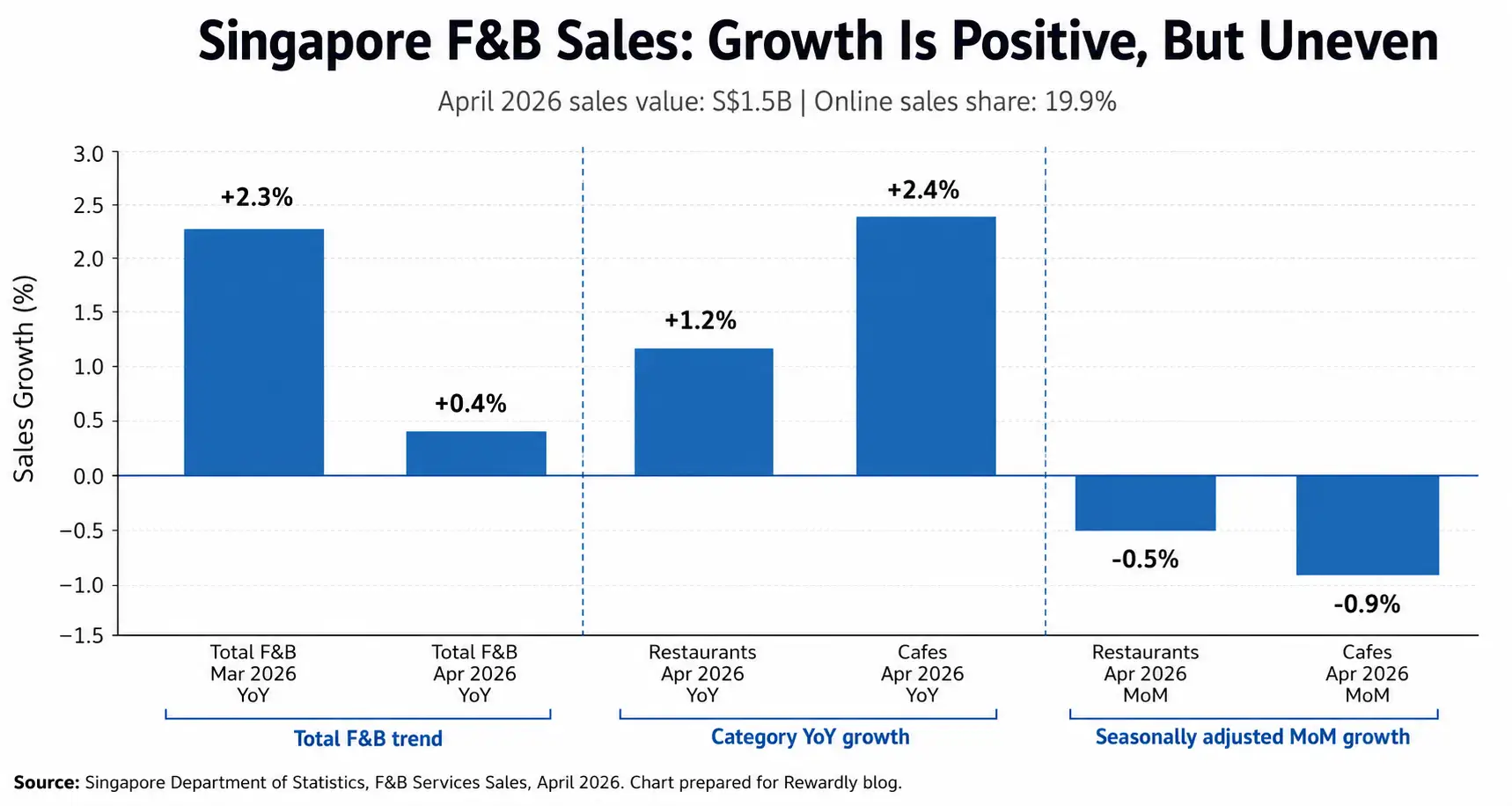
According to the Singapore Department of Statistics, total F&B services sales increased 0.4% year-on-year in April 2026, moderating from 2.3% growth in March 2026. Total F&B sales value for April 2026 was estimated at S$1.5 billion, with 19.9% from online sales.
At first glance, this still looks positive. But the details show a more competitive market.
In April 2026, restaurants grew 1.2% year-on-year and cafes grew 2.4% year-on-year. However, on a seasonally adjusted month-on-month basis, restaurant sales fell 0.5% and cafe sales fell 0.9%.
This means operators cannot depend only on walk-in traffic or general market growth. Restaurants and cafes need better ways to increase repeat visits, improve service speed, reduce mistakes, and protect margins.
Online ordering is now part of normal F&B behaviour
Nearly one-fifth of Singapore F&B sales came from online channels in April 2026. More importantly, SingStat’s definition of online F&B sales includes orders received remotely through websites, third-party platforms, food delivery platforms, or mobile apps — but excludes in-premise kiosk and QR code orders.
This is important for restaurants and cafes.
A customer may order through GrabFood, scan a QR code at the table, use a self-ordering kiosk, call for takeaway, or pay at the counter. To the customer, these are all normal ordering experiences. To the operator, they can become messy if every channel is managed separately.
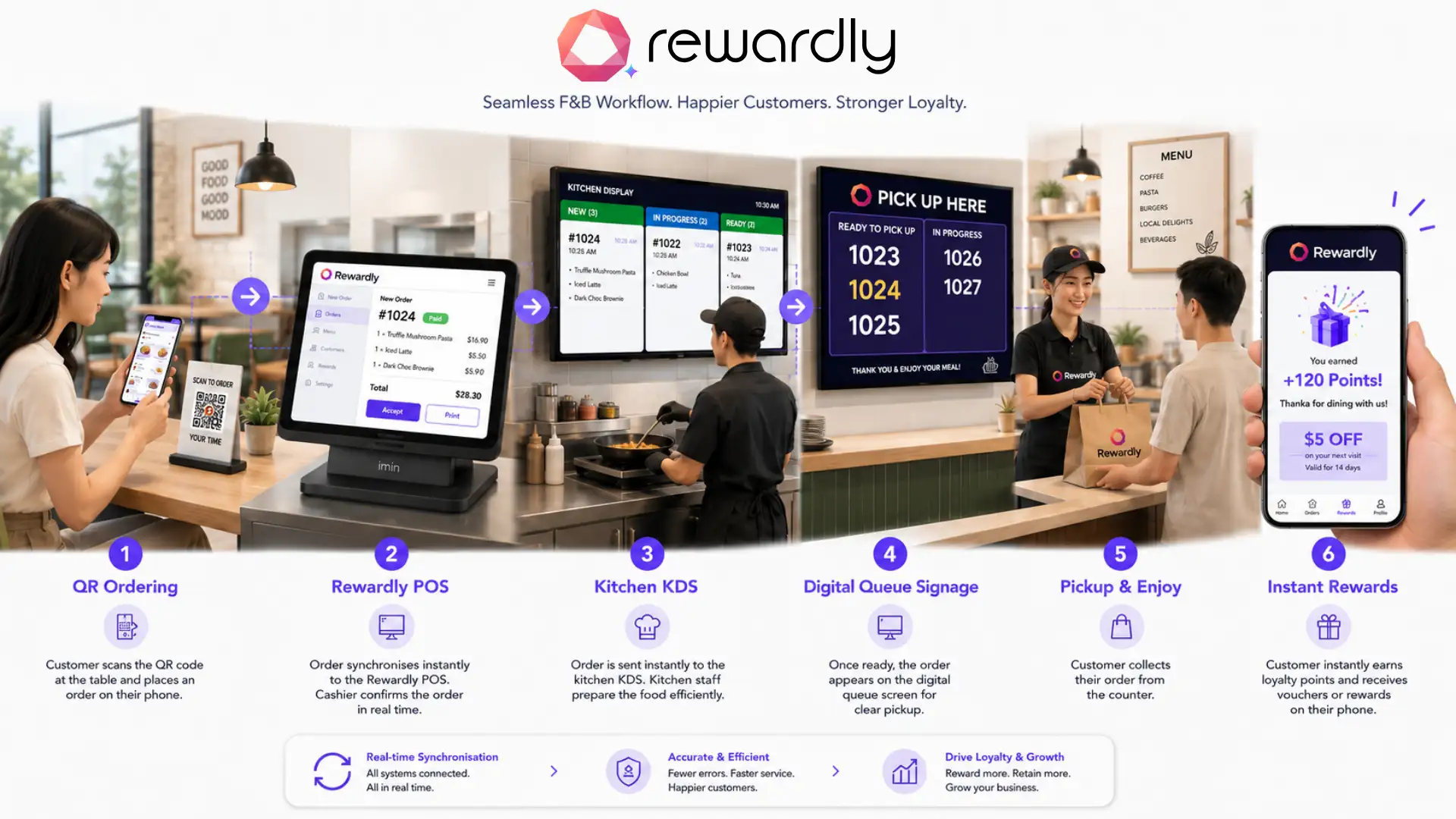
That is why modern F&B POS systems need to connect ordering channels into one operational view. A restaurant should be able to manage dine-in, takeaway, delivery, QR ordering, kiosk ordering, and counter sales without updating menus, prices, and stock separately in five different places.
Labour cost pressure makes automation more important
Singapore’s Food Services Progressive Wage Model is also raising the pressure on operators to improve productivity. MOM states that food service employers must meet PWM wage and training requirements for Singapore citizen and permanent resident food service workers who meet the coverage criteria.
For Category A quick-service roles, the monthly gross wage requirement for a food or drink stall assistant rises from at least S$2,080 to at least S$2,220 from 1 July 2026, and reaches at least S$2,500 from 1 July 2028.
This does not mean technology should replace hospitality. But it does mean restaurants and cafes should reduce repetitive manual work where possible.
Examples include:
Letting customers order through QR menus or kiosks
Sending orders directly to the kitchen display system
Reducing manual re-keying from delivery platforms
Automating loyalty points and voucher redemption
Syncing payment records automatically with POS sales
When staff spend less time keying orders manually, they can focus more on food preparation, service quality, cleaning, upselling, and customer experience.
Tourism supports demand, but not every outlet benefits equally
Tourism remains a positive factor for Singapore F&B. The Singapore Tourism Board expects 17 to 18 million international visitor arrivals in 2026, with approximately S$31.0 billion to S$32.5 billion in tourism receipts.
This is good news for restaurants and cafes in malls, hotels, airports, tourist districts, and lifestyle destinations.
However, neighbourhood cafes and independent restaurants cannot rely on tourism alone. For many outlets, sustainable growth still depends on local repeat customers. This is where loyalty, membership, prepaid packages, birthday vouchers, customer segmentation, and reactivation campaigns become important.
A POS system should not only record what happened today. It should help the business bring customers back tomorrow.
Singapore’s digital direction is clear: integrated F&B systems
Enterprise Singapore and IMDA’s Food Services Industry Digital Plan highlights the shift in consumer behaviour towards digital ordering, e-commerce, and food delivery. It also identifies tight labour market conditions and increasing labour costs as key challenges for food service SMEs.
The same Food Services IDP describes a “connected business suite” that integrates front-of-house tools such as digital ordering, payment, POS, and online shop with back-of-house functions such as CRM, inventory, accounting, and kitchen management. It also connects F&B companies with logistics platforms, food delivery platforms, and marketplaces.
This confirms an important point: the future of F&B technology is not a standalone cashier machine.
It is an integrated operating system.
What this means for restaurants and cafes choosing a POS system
For Singapore restaurants and cafes, choosing a POS system should no longer be based only on price or whether it can print receipts.
A modern F&B POS system should help with six areas.
1. Faster ordering during peak hours
Lunch, dinner, and weekend rush periods can make or break an outlet. QR ordering, self-ordering kiosks, and kitchen display systems can reduce queue pressure and help staff process more orders with fewer mistakes.
2. One menu across multiple channels
Many restaurants now sell through dine-in, takeaway, delivery, pre-order, QR ordering, and kiosk ordering. Updating the same menu repeatedly across different systems wastes time and increases the risk of mistakes.
A stronger POS setup should allow menu, pricing, modifiers, bundles, availability, and sold-out items to be managed centrally.
3. Better customer retention
Growth does not only come from new customers. It also comes from getting existing customers to return.
For cafes, this could mean digital stamps, prepaid coffee packages, birthday rewards, and member-only promotions. For restaurants, it could mean dining credits, vouchers, points, cashback, or targeted campaigns.
4. Payment and sales reconciliation
Singapore customers pay in many ways, including cards, PayNow, e-wallets, and QR payments. The POS system should help operators reduce payment friction and reconcile transactions accurately.
5. Inventory and availability control
Restaurants and cafes lose trust when customers order items that are no longer available. Inventory-linked menu control helps reduce overselling and improves order accuracy.
6. Multi-outlet readiness
Even if a business has only one outlet today, it may expand into pop-ups, kiosks, second outlets, or franchise models. A POS system should not block future growth.
Where Rewardly fits in
Rewardly is built for Singapore F&B, restaurant, cafe, and retail businesses that need more than basic cashiering. Rewardly connects POS, payments, QR ordering, self-ordering kiosks, loyalty, inventory, and automation in one cloud platform.
For cafes and restaurants, Rewardly’s platform supports workflows such as table QR ordering, pickup, delivery, advance pre-orders, self-ordering kiosks, payment processing, loyalty, and inventory availability control.
Rewardly’s pricing page also shows plans for different business stages, from hawkers and home-based businesses to cafes, restaurants, events, roadshows, multi-outlet businesses, and franchise or enterprise use cases. The cafe and restaurant plan includes POS, QR ordering, self-ordering kiosk, KDS, eSignage, GrabFood integration, payments, PayNow, LoyaltyOS, support, and Open API access.
In simple terms, Rewardly is not just a POS system. It is designed to help F&B operators manage the full order journey:
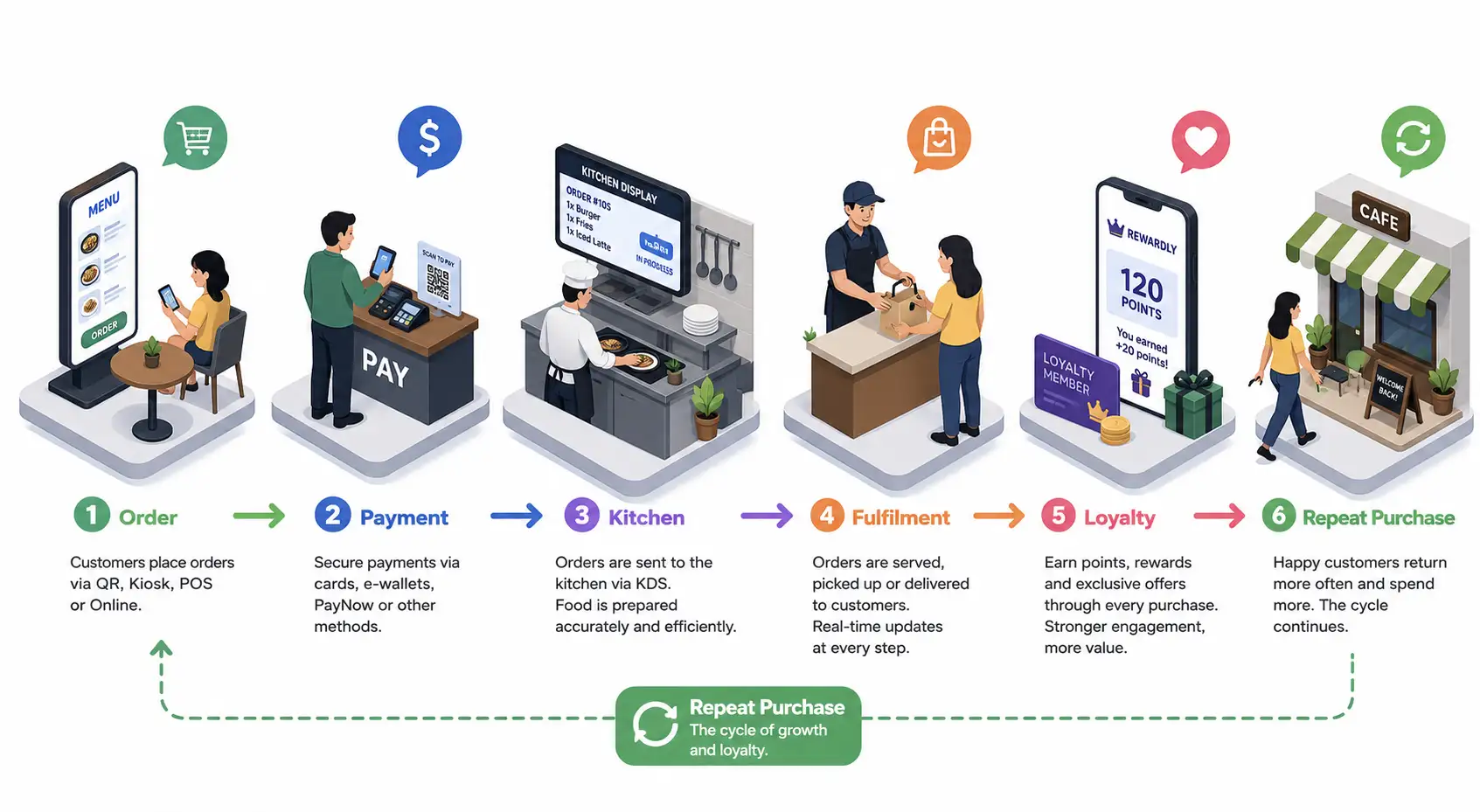
Order → Payment → Kitchen → Fulfilment → Loyalty → Repeat Purchase
Practical opportunities for Singapore F&B operators in 2026
Here are a few areas where restaurants and cafes can use technology to improve performance.
1. Turn cafe regulars into members
Cafes often have repeat customers, but many still do not capture customer data. A simple loyalty setup can help turn daily coffee buyers into identifiable members.
Examples include prepaid coffee packs, digital stamps, birthday rewards, member pricing, and return-visit vouchers.
2. Reduce queue pressure with QR ordering and kiosks
For quick-service restaurants, dessert shops, bubble tea-style concepts, and lunch-heavy cafes, QR ordering and kiosks can help reduce bottlenecks at the cashier.
This is especially useful during peak periods when staff are stretched.
3. Bring delivery customers back directly
Delivery platforms are important, but they do not always help merchants build direct customer relationships. Restaurants can encourage delivery customers to return through direct ordering links, QR vouchers, membership campaigns, or pickup discounts.
The goal is not to abandon delivery platforms. The goal is to build a healthier mix of platform orders and direct repeat customers.
4. Use loyalty to protect margins
Discounting is easy, but it can hurt margins. A better loyalty strategy rewards the right behaviour.
For example, a cafe can reward weekday visits, off-peak spending, prepaid purchases, referrals, or repeat orders instead of offering blanket discounts to everyone.
5. Prepare for multi-outlet growth early
Many F&B businesses only think about systems after expansion becomes painful. But multi-outlet growth is easier when the foundation is ready early.
Menu control, outlet reporting, centralised loyalty, payment reconciliation, inventory visibility, and role-based staff access become much more important once a brand has more than one location.
Final takeaway
Singapore’s F&B industry is not standing still. Restaurants and cafes are operating in a market where growth is modest, labour costs are rising, digital ordering is normal, and customer retention matters more than ever.
A basic POS system may still record sales, but it may not be enough to support the way F&B businesses now operate.
For restaurants and cafes, the right technology should help answer these questions:
Can we serve faster?Can we reduce manual work?Can we manage all order channels in one place?Can we understand our customers better?Can we bring customers back more often?Can we scale without rebuilding our systems later?
That is the role of a modern F&B POS system.
And that is the problem Rewardly is built to solve.
Have More Questions? Check our FAQ
What should a cafe POS system in Singapore include?
A cafe POS system should support fast order-taking, QR ordering, payment integration, loyalty, inventory tracking, reporting, and customer retention tools. For busy cafes, kiosk ordering and kitchen display systems can also help reduce queue pressure.
Why is QR ordering useful for restaurants and cafes?
QR ordering lets customers browse the menu and place orders from their own phones. This can reduce manual order-taking, improve order accuracy, and help staff focus on fulfilment and service.
Is loyalty important for F&B businesses?
Yes. In a competitive F&B market, repeat customers are often more valuable than one-time customers. Loyalty programmes, vouchers, prepaid packages, and member campaigns can help restaurants and cafes increase repeat visits.
Why should restaurants use an integrated POS system?
An integrated POS system reduces the need to manage separate tools for sales, payments, QR ordering, delivery, inventory, and loyalty. This helps operators save time, reduce errors, and get clearer business data.
Is Rewardly suitable for cafes and restaurants?
Rewardly is designed for Singapore F&B businesses including cafes, restaurants, hawkers, QSRs, events, roadshows, multi-outlet operators, and franchise businesses. It connects POS, QR ordering, kiosk ordering, payments, loyalty, inventory, and automation in one platform.